


Opens in a new tab. Your article title and link are shared only with the AI assistant you choose.
A round robin tournament guarantees every participant a match against every opponent in the group, unlike a knockout bracket. The 2026 FIFA World Cup used this principle for 48 teams in 12 groups of four, producing 72 group-stage matches. The challenge is fitting those games into a workable schedule.
You need more than a list of matchups to run the format well. Clear scoring rules, sensible rest periods, and a reliable plan for ties matter just as much as the fixtures themselves. This guide shows you how to calculate matches, organize each round, track standings, and decide whether round robin suits your event.
What Is a Round Robin Tournament and How Does It Work?
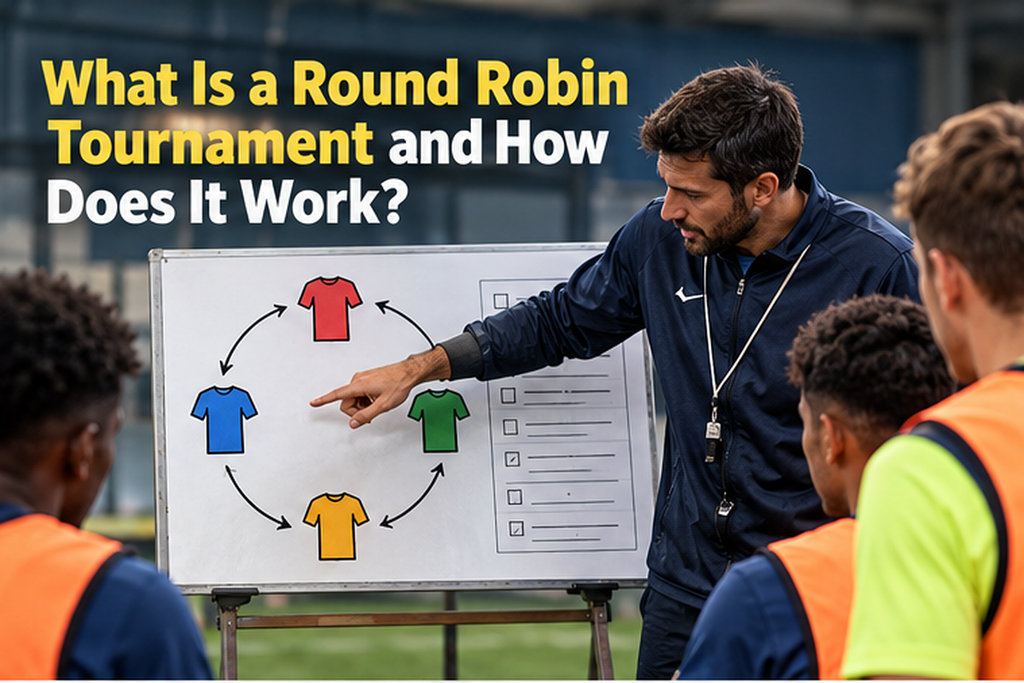
In a round robin, every player or team faces every other player or team in its group. A single round robin schedules each pairing once, giving four teams six matches altogether. A double round robin repeats the pairings, often once at home and once away.
Unlike knockout play, one defeat does not eliminate a team. Organizers rank participants by match results and published scoring rules. The winner may take the title outright, or the leaders may advance to playoffs.
A standings board helps competitors follow their progress. A leaderboard maker may present rankings, provided it supports your scoring and tiebreaker rules. Keep an official match record in case the display needs correcting.
The format rewards consistent results across multiple opponents. At the 2025 FIFA Club World Cup, 32 clubs played in eight groups of four, totaling 48 group matches. Splitting the field into pools avoided a far longer all-play-all competition.
A complete round robin gives each team equal opponent coverage. It does not guarantee equal rest, travel, or playing conditions. Check those differences before publishing fixtures.
Must-know Tip: Decide whether standings determine a champion or playoff qualification. That choice affects your tiebreaker rules. Publish the decision before play begins.
Doubles events need another decision: whether rankings belong to fixed pairs or individual players. Changing partners can alter matchups and scoring, especially when every player earns individual points across several partners. State the entry type explicitly before you generate and publish fixtures.
Round Robin Tournament Formats, Formulas, and Match Counts
Single, Double, and Partial Round Robin
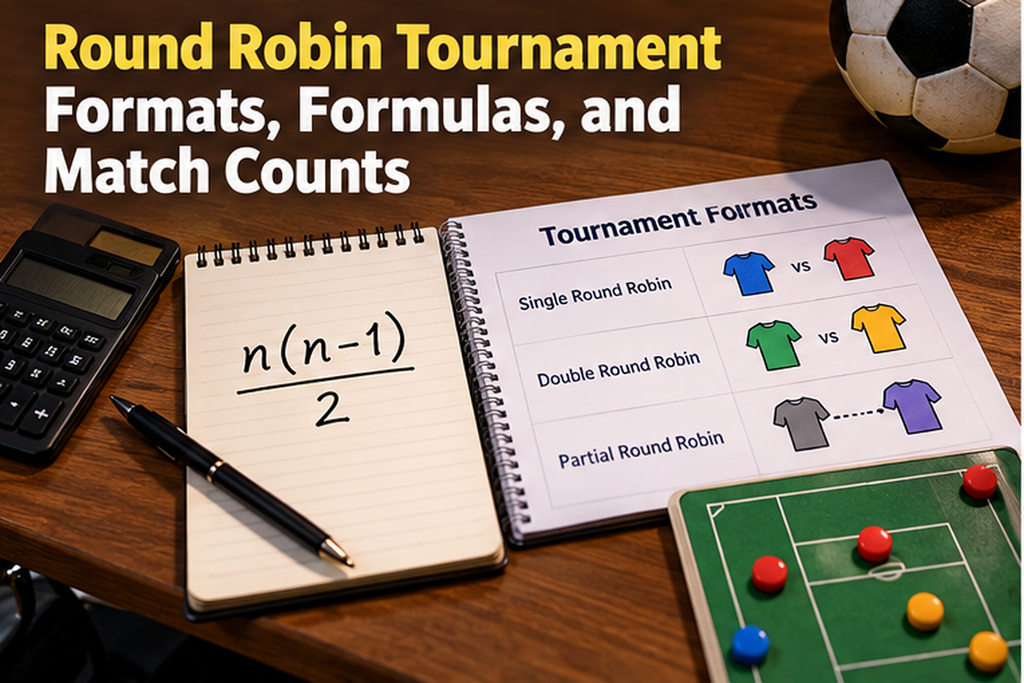
Single round robin means one meeting per opponent, while double means two. Triple round robin adds a third meeting and considerably more games. Partial round robin omits some pairings and is not a complete all-play-all competition.
For n teams, single round robin matches equal n × (n − 1) ÷ 2. Double round robin matches equal n × (n − 1), giving each team twice as many games. Playoff fixtures are additional.
| Teams | Single Matches | Double Matches | Single Rounds |
| 4 | 6 | 12 | 3 |
| 5 | 10 | 20 | 5 |
| 6 | 15 | 30 | 5 |
| 8 | 28 | 56 | 7 |
| 10 | 45 | 90 | 9 |
Even-numbered fields need n − 1 rounds with one game per team per round. Odd-numbered fields need n rounds, with one bye each time. The table excludes playoffs, and a double round robin also doubles the rounds.
U.S. soccer demonstrates this growth. The 2024 NWSL had 14 teams, 26 games per club, and 182 fixtures; in 2026, 16 clubs were scheduled for 30 games each, totaling 240 fixtures. Two added clubs increased the schedule by 58 games.
Must-know Tip: Calculate fixtures before booking venues. Moving from eight to ten teams increases a single round robin from 28 to 45 games. Budget for matches, not just participants.
How to Create a Round Robin Tournament Schedule
Use the Circle Method for Even Teams
Arrange teams in a circle, fixing one position. Pair opposite positions, then rotate the others before each new round. With four teams: Round 1, A–D and B–C; Round 2, A–C and D–B; Round 3, A–B and C–D.
Check the schedule for missing or repeated matchups. Each four-team participant must face three different opponents. Run games concurrently when you have sufficient courts and officials.
Handle Five Teams Without Missing a Game
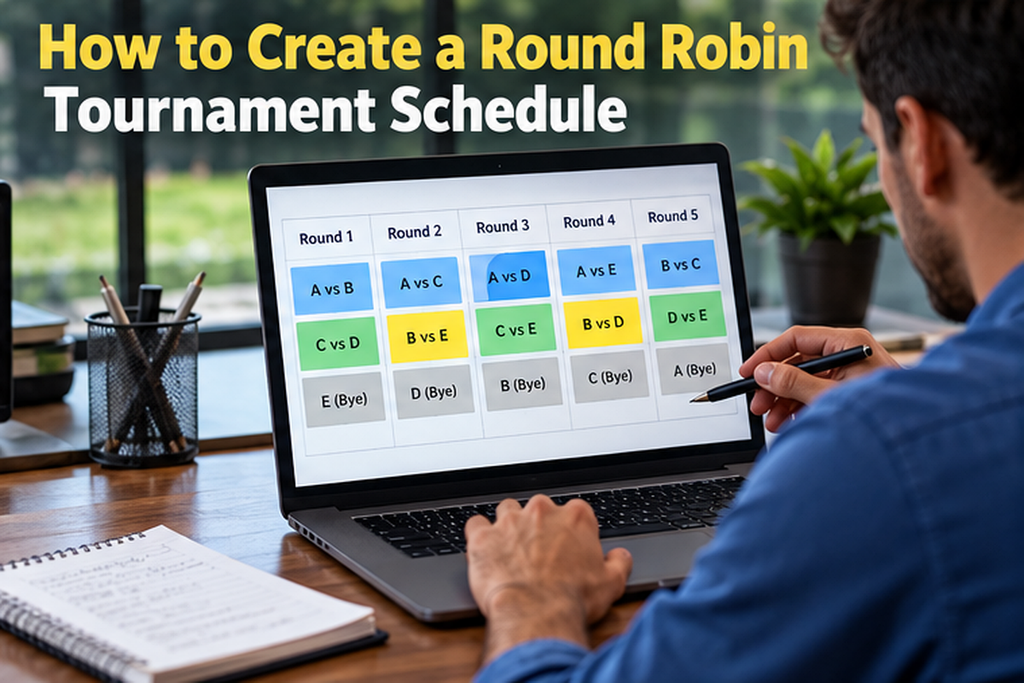
For odd fields, add a dummy position for byes. Five teams need ten games across five rounds. This schedule contains each pairing once:
| Round | Match 1 | Match 2 | Bye |
| 1 | A–B | C–D | E |
| 2 | A–C | B–E | D |
| 3 | A–D | C–E | B |
| 4 | A–E | B–D | C |
| 5 | B–C | D–E | A |
Add times, courts, and breaks after confirming matchups. The 2025 WTA Finals split eight singles players into two groups of four, totaling 12 group matches. Small pools allow complete opponent coverage without one enormous schedule.
Check recovery periods. Valid fixtures can still create unfairly short recovery times. Adjust start times without losing matchups.
Must-know Tip: At the 2025 Next Gen ATP Finals, player Dino Prizmic said, “Every win is very important, and you have to stay balanced after a group defeat, as you can come back.” Schedule enough recovery between games. Even winning teams need breaks.
Round Robin Scoring, Standings, and Tiebreaker Rules
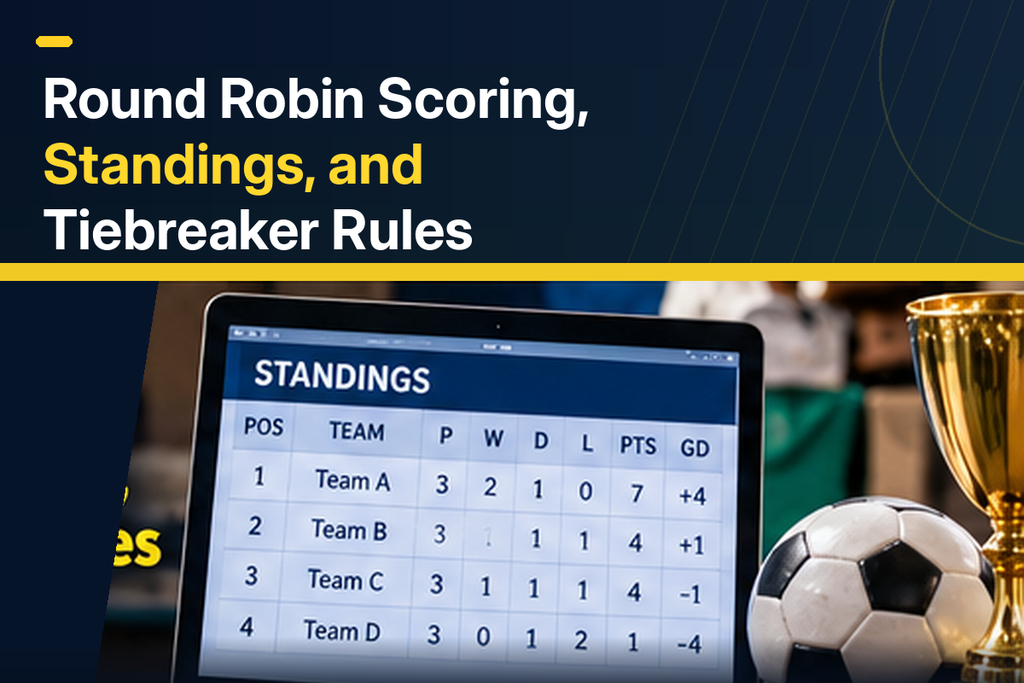
Publish your scoring rules before play begins. Soccer commonly awards three points for a win, one for a draw, and none for a loss, while other sports rank match wins or sets. Record matches, results, points, and tiebreaking statistics.
Example of a Four-Team Standings Table
In this illustrative group, A defeats B 2–1 and D 3–0, then draws C 1–1. B beats C 2–0 and draws D 1–1; C beats D 1–0. The six results yield these standings:
| Team | Played | W-D-L | Points | Goal Difference |
| A | 3 | 2-1-0 | 7 | +4 |
| B | 3 | 1-1-1 | 4 | +1 |
| C | 3 | 1-1-1 | 4 | -1 |
| D | 3 | 0-1-2 | 1 | -4 |
B ranks above C on both goal difference and head-to-head results. Decide which tiebreaker takes precedence before play. Three-way ties may require a mini-table of games among the tied teams.
Suppose A beats B, B beats C, and C beats A. Their head-to-head wins form a cycle. Your next published tiebreaker must separate them.
Professional tiebreakers vary. UEFA EURO 2024 had 24 teams in six groups and 36 group games; the 2025 WTA Finals used tennis-specific measures for tied records. Adopt rules that suit your event.
Must-know Tip: Publish forfeiture and abandoned-match rules. These decisions can change standings and playoff qualification. Let one authorized official correct recorded results.
How to Organize a Fair Tournament and Choose the Right Format

Set your participant list, venues, game lengths, scoring, and playoff rules first. Next create fixtures and check rest gaps. Assign one official to manage changes.
Before the opening game, confirm these essentials:
- Assign each team a unique name or number.
- Reserve enough courts, fields, referees, and buffer time.
- Explain byes, forfeits, tiebreakers, and late arrivals.
- Provide a visible schedule and a single official standings record.
- State whether group winners advance to knockout games.
Case Study: A Five-Team Community Soccer Day
In this fictional example, Michael runs a five-team soccer contest on two fields. He schedules two concurrent games in each of five rounds. Five 50-minute slots, including 40 minutes of play and ten for reset, take 250 minutes before delays.
Some teams must play consecutive rounds, so Michael schedules a water break. He also appoints one scorekeeper to confirm results. Match totals alone cannot guarantee a comfortable event.
Round robin offers more games than single elimination, which can remove teams after one loss. Double elimination allows a second loss before exit, while Swiss pairs competitors according to results without requiring every matchup. Pool play simply divides teams into groups that may each use round robin.
The 2025 Women’s EURO used four groups of four, creating 24 group matches. WTA Finals director Garbiñe Muguruza said in 2025: “It gives you that opportunity to still win even if you lose the match.” That second chance is valuable, but it requires more time.
Conclusion
A round robin tournament works best when you want participants to face a broad and predictable set of opponents, rather than risk immediate elimination. You can build a fair event by calculating fixtures first, choosing a clear ranking method, and checking whether your venues and time slots can accommodate every match. A complete single round robin is especially practical for smaller groups, while larger fields usually benefit from separate pools.
Do not treat the mathematics as the entire plan. Byes, breaks, uneven travel, forfeits, and three-way ties can still affect how participants experience the competition. When the schedule and rules are clear before play starts, everyone has a better chance to focus on the games instead of arguing about the format with teammates.
Use the questions below to settle the final details before publishing your tournament schedule.
Frequently Asked Questions About Round Robin Tournaments
How Does a Round Robin Tournament Work?
Each team faces all its group opponents. Results determine standings, or the top finishers advance to playoffs. Nobody is removed after a single group loss.
How Many Games Are in a Four-Team Round Robin?
A single round robin with four teams has six games. Each team plays three matches. A double round robin has twelve games.
How Many Games Are in a Five-Team Round Robin?
Five teams create ten unique matchups in a single round robin. Each team plays four opponents. One team rests during each of five rounds.
What Is the Formula for Round Robin Matches?
Use n(n − 1)/2 for a single round robin with n teams. Double that result for two meetings per opponent. Count playoff matches separately.
How Many Rounds Does Round Robin Need?
For an even number of teams, a single round robin usually takes n − 1 rounds. For an odd number, it takes n rounds. This assumes one game per team per round.
What Happens With an Odd Number of Teams?
One participant receives a bye in each round. A fair schedule rotates that rest period. Every pairing still appears once by the end.
How Are Three-Way Ties Broken?
Follow the published tournament rules. Organizers often compare results among tied teams, then use score or set measures. Avoid inventing a new criterion mid-event.
Is Round Robin the Same as Pool Play?
Not exactly, because pool play divides competitors into groups. Those groups often use round robin fixtures. Pool winners may then enter a knockout bracket.
Is Round Robin Better Than Single Elimination?
Round robin guarantees more opponent exposure and reduces the effect of one bad match. Single elimination needs fewer total games. Choose based on your time and budget.
Can You Use Round Robin for Pickleball or Tennis?
Yes, either sport can use individual or fixed-team round robins. Rotating-partner doubles needs extra rules because partners change. Rank players or teams consistently.
What Is the Best Way to Track Scores?
Use one official score sheet or spreadsheet and update it after every game. Display current rankings separately if helpful. Check that any automatic ranking tool follows your written tiebreakers.



Comments
0 responsesNo comments yet. Be the first to share your thoughts.