


Opens in a new tab. Your article title and link are shared only with the AI assistant you choose.
Single vs double elimination can determine whether your tournament ends on schedule or keeps players waiting for another round. The difference sounds small: one loss ends a run in one format, while two losses are needed in the other. Yet that rule affects every decision from staffing to championship scheduling.
Consider the 2026 NCAA baseball championship, which placed 64 teams into 16 four-team double-elimination regionals, while the familiar NCAA basketball bracket remained a knockout competition. Neither approach is automatically better, because each solves a different problem. Here is how to compare the brackets, calculate matches, plan resources, and choose a format that works for your competitors.
What Is the Difference Between Single and Double Elimination?
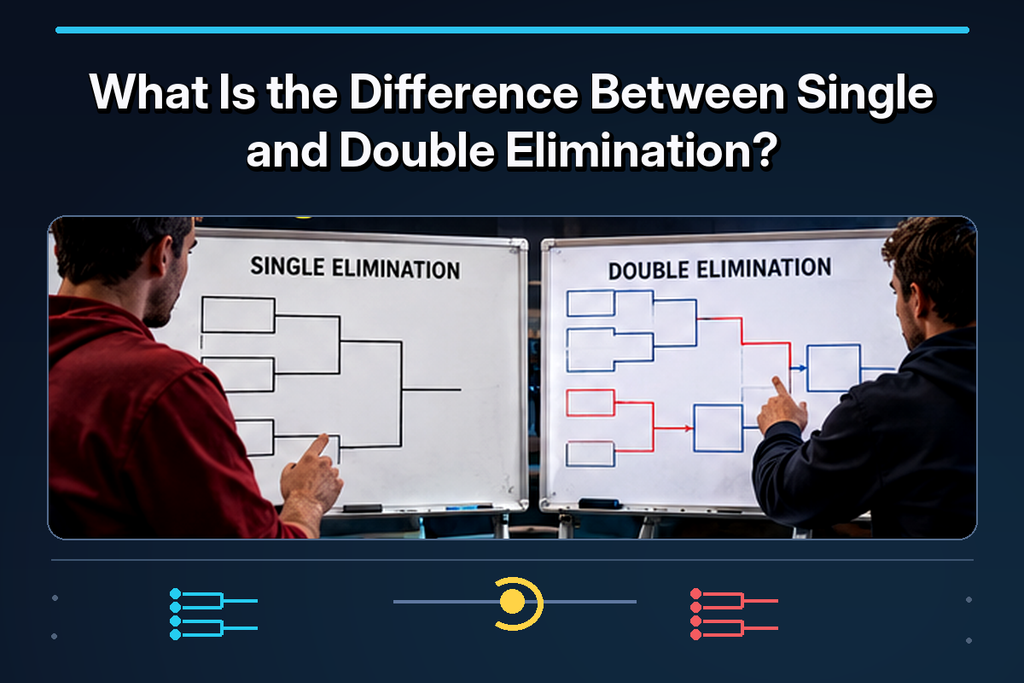
In single elimination, one match loss removes a player or team from championship contention. Winners continue through successive rounds until one undefeated competitor remains. It delivers a champion with relatively few matches.
Double elimination requires a competitor to lose twice before leaving the championship bracket. Everyone starts in the winners bracket, and a first loss moves that competitor into the losers bracket. A lower-bracket survivor can still win the title.
A bracket records who plays next, but a leaderboard serves a different purpose. When an event awards points across separate contests, a leaderboard maker can display standings without replacing the elimination draw. Separate rankings from the championship bracket to avoid confusion.
Single elimination guarantees one match per participant and asks little of the organizing team. Standard double elimination gives players a second opportunity but needs a lower bracket and potentially a second final. For eight entrants, that means seven matches versus fourteen or fifteen.
The difference appears in major competitions, not just community events. The 2026 NCAA baseball tournament used 16 four-team double-elimination regionals, while the 2026 Evo fighting-game event listed double elimination across its 12 featured titles. Both events prioritize competitive opportunities.
Must-know Tip: FACEIT’s tournament guidance states, “If a team loses one match, the team is immediately eliminated from the tournament.” That sentence defines single elimination more reliably than a casual reference to a knockout bracket. Tell players whether your event has consolation matches before registration closes.
How Do Winners Brackets, Losers Brackets, and Finals Work?
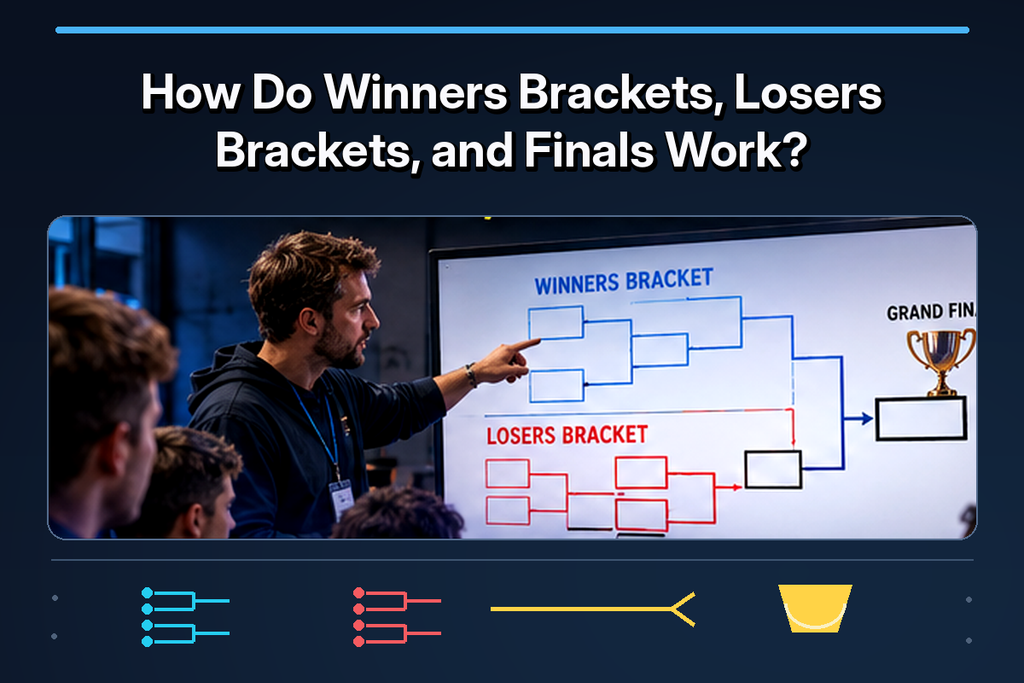
Picture an eight-player single-elimination draw starting with four quarterfinal matches. Four winners reach the semifinals, two reach the final, and one earns the title after three victories. Seven matches fit into three rounds, and everyone except the champion leaves after a single loss.
In double elimination, those opening-round losers instead enter the lower bracket. Upper-bracket winners continue undefeated, while lower-bracket losses send competitors home. The lower-bracket survivor ultimately challenges the unbeaten finalist.
Why the Grand Final Might Need Two Matches
A true double-elimination final gives the unbeaten participant a second chance. If the lower-bracket challenger wins the first final, both finalists now have one loss, so a bracket-reset match determines the champion. If the upper-bracket finalist wins immediately, no reset is needed.
Not every organizer uses that rule. FACEIT’s January 2025 documentation confirms its organizers can enable or disable double finals. Announce your policy because it affects fairness and scheduling.
The 2026 VALORANT Champions Shanghai event offers a current competitive example. Riot Games placed 16 teams into four opening groups, advanced eight to the playoffs, and used double elimination in the playoffs. Its schedule separated the lower-bracket final and grand final, illustrating scheduling dependencies.
Must-know Tip: A grand-final reset is not simply an optional bonus game when you promise true two-loss elimination. Without a reset, an undefeated finalist may be eliminated by a first loss in the championship match. Choose the rule deliberately and describe it on the published bracket.
How Many Matches, Rounds, and Byes Do You Need?
You can calculate the usual single-elimination total as entrants minus one, or N − 1. That works because every match removes exactly one contender from the title race. A 12-team single-elimination event needs 11 matches, while a 32-team field needs 31.
For standard double elimination, plan for 2N − 2 matches, or 2N − 1 if the final resets. The same 12-team event requires 22 or 23 matches, while 32 entrants require 62 or 63. Those totals exclude placement games and unusual tournament rules.
With 16 entrants, the comparison is 15 matches against 30 or 31. With four entrants, it is three against six or seven. Every additional match affects the available playing slots.
How Seeding and Byes Change the Draw
Byes advance entrants without requiring an opening match, and they do not increase the total matches needed to crown a champion. Twelve entrants in 16 slots require four byes. Check lower-bracket routing before assigning opponents, so byes do not create unfair or repeated matchups.
Don’t confuse match counts with rounds or match duration. Sixteen entrants need four single-elimination rounds, but double elimination adds lower-bracket stages. Later matchups depend on earlier winners and losers.
Must-know Tip: Seed the strongest participants apart when your competition has trustworthy rankings, but explain how those rankings were determined. Random draws are also legitimate for casual events if everyone understands the process. Either way, finalize byes before the opening match to avoid disputes.
How Much Time, Money, and Staff Does Each Format Require?
The real constraint is not merely how many matches appear on the bracket. You must also account for match length, simultaneous playing areas, check-in, rest, equipment changes, and delayed results. A second bracket creates extra handoffs even if you have enough courts to run several games at once.
Start with a capacity estimate: multiply the number of available courts by the number of match slots each court can host. Two courts operating for four hours with 25-minute slots offer nine complete slots per court. That is 18 theoretical match slots combined, before breaks or dependencies reduce actual capacity.
Worked Case Study: Michael’s Twelve-Team Event
Michael is organizing a fictional community tournament with 12 teams, two courts, and four hours of booked venue time. The single-elimination option needs 11 matches, while double elimination needs 22 or 23; with 25-minute slots, the absolute workload floor is six slots versus eleven or twelve. Those floors equal 150 minutes versus 275 or 300 minutes if every usable slot is filled, before rest, changeovers, or bracket delays.
Michael has just 240 minutes, so double elimination cannot fit those assumptions. He chooses single elimination and offers consolation games if time remains. That choice protects the event’s finish time.
Costs also depend on venue and sport. Longer events may raise rental, staffing, broadcasting, and overtime bills. Check the worst-case schedule before announcing your finish time, especially when a facility charges overtime or requires immediate court clearance.
Which Tournament Format Should You Choose?
Choose single elimination for a tight deadline, large field, or small organizing team. Spectators also understand its immediate stakes. However, one poor game can eliminate a favorite.
Double elimination suits entrants who expect a second competitive chance. It softens the impact of an upset but never guarantees the strongest player wins. Expect longer schedules and more administration.
Use these checks before committing:
- Choose single elimination if courts, staff, or playing hours are tightly limited.
- Choose double elimination if two-loss protection matters more than speed.
- Use a consolation bracket if extra games matter but a full lower bracket does not fit.
- Consider round robin when every entrant should face several different opponents.
Recent events show these preferences in practice. At Evo 2026, the Street Fighter 6 rules used double elimination, with best-of-three game sets before the top eight and best-of-five sets afterward. In the 2026 NCAA baseball tournament, four-team double-elimination regionals advanced winners toward a separate best-of-three super-regional stage.
Must-know Tip: SnapBracket’s organizing guide notes, “The right choice depends on your time, staffing, venue limits, and how much competitive depth your event needs.” Turn that advice into a written checklist rather than relying on instinct. Confirm the format, reset policy, tie rules, forfeits, and reporting process before the first matchup.
Publish rules for no-shows and withdrawals too. A forfeit might count as a loss or trigger disqualification, depending on your policy. Decide that before someone misses a match.
Conclusion
Single vs double elimination is a practical choice between quick completion and a more forgiving route to the title. If you have a fixed venue booking, limited officials, or many entrants, single elimination gives you a manageable draw with fewer match dependencies. If players value recovery after an early defeat, double elimination gives them that opportunity but asks much more of your schedule.
Count the matches, confirm court capacity, assign byes, and announce final rules before committing. Test a schedule that includes breaks and a potential reset. The best format is one you can execute fairly and finish reliably while protecting volunteers, spectators, and traveling teams who depend on your timetable.
Still weighing the options? The questions below clarify rules that can change your choice. Use them to check your proposed format before registration opens.
Frequently Asked Questions
Is Double Elimination Better Than Single Elimination?
Not necessarily, because goals differ. Double elimination protects against one loss. Single elimination saves time.
How Many Games in Eight-Team Double Elimination?
The usual total is 14 matches. A final reset makes 15. Extra placement games add more.
Can You Win After One Loss?
Yes, you enter the lower bracket. Winning there can return you to the final. A reset may be needed.
Does Everyone Play Twice?
Standard rules give entrants two losses before elimination. Forfeits can replace played matches. Check the tournament policy.
What Is a Bracket Reset?
The lower-bracket winner beats the undefeated finalist. Both now have one loss. Another final decides the champion.
Can Six Teams Use Elimination?
Yes, six teams can compete. Single elimination needs five matches. Double elimination needs ten or eleven.
How Many Byes for Twelve Teams?
A 16-slot bracket accommodates 12 teams. Four receive opening-round byes. Announced seeding rules determine their allocation.
Is Double Elimination Fairer?
It cushions one unexpected loss. It cannot remove every source of unfairness. Good seeding and clear rules still matter.
Can Double Elimination Finish in One Day?
Yes, with sufficient courts and short matches. Large fields may require more days. Leave time for a reset.
Should You Use Best-of-Three?
You can use best-of-three in either format. Each bracket match may then require three games. Budget that time carefully.




Comments
0 responsesNo comments yet. Be the first to share your thoughts.